
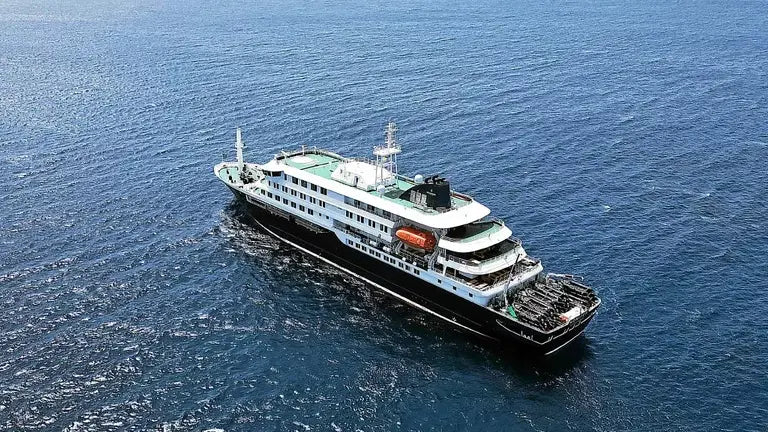
Health: hantavirus outbreak on MV Hondius under surveillance by health authorities
Three deaths and several suspected cases have been reported on an expedition ship, amid heightened international vigilance regarding infectious risks.
A health incident involving a hantavirus is currently being closely monitored by international authorities following the deaths of three passengers aboard the expedition vessel MV Hondius.
According to the World Health Organization (WHO), the victims are a Dutch couple and a German national. The ship, flying the Dutch flag, was en route between Ushuaia and the Cape Verde archipelago when it was forced to stop off Praia.
A Contained but Monitored Situation
The MV Hondius, carrying 88 passengers and 59 crew members from 23 nationalities, has been at anchor for several days.
Three suspected cases are to be evacuated ashore in the coming hours, including two crew members presenting symptoms but in a stable condition.
Local and international health authorities are coordinating operations to limit any risk of spread.
Limited Transmission Risk
The WHO emphasizes that hantavirus, while it can cause acute respiratory syndrome, does not present the same level of contagiousness as diseases like influenza or COVID-19.
According to initial analyses, the initial infections were likely contracted off the ship, before limited human-to-human transmission on board.
The exact variant of the virus has not yet been identified, but the hypothesis of an Andes-type virus — one of the few that allows human-to-human transmission — is currently being studied.
Logistical Management Under Strain
Passengers and crew are to be gradually disembarked, examined, and cared for before repatriation to their countries of origin.
Once the initial evacuations are complete, the ship is expected to resume its journey to the Canary Islands, where a health protocol is anticipated upon arrival.
Furthermore, the ship's doctor, currently in serious condition, is to be transferred by medical aircraft at the request of the Dutch authorities.
Ongoing International Coordination
The management of this incident involves several stakeholders: Cape Verdean authorities, the World Health Organization, and the passengers' countries of origin.
The objective remains twofold:
– contain the chain of contamination
– precisely identify the origin of the infectious outbreak
Analyses are currently underway in South Africa to determine the exact nature of the virus.
A Reminder of Vulnerabilities in Isolated Environments
Beyond this incident, the situation highlights the health challenges associated with isolated environments such as expedition ships.
The concentration of populations in closed spaces, combined with the international mobility of passengers, constitutes a specific risk factor.
In this context, rapid intervention and international coordination appear to be crucial elements.
Vigilance Without a Global Alert
At this stage, health authorities rule out any large-scale spread scenario.
The episode is considered circumscribed, although closely monitored.
However, it illustrates the need to maintain surveillance systems for emerging or rare diseases, in an environment marked by intensifying international flows.



Leave a comment
This site is protected by hCaptcha and the hCaptcha Privacy Policy and Terms of Service apply.