
Article: Iraq: Are the players really the problem… or is Graham Arnold a prisoner of a system beyond his control?
Iraq: Are the players really the problem… or is Graham Arnold a prisoner of a system beyond his control?
After a forty-year wait, Iraq's return to the World Cup was supposed to mark a renaissance. The elimination had the opposite effect: it now forces Iraqi football to confront a question it often prefers to avoid. Do some players truly have international-level talent? And if the answer is no, why do they continue to be selected, start, and be protected?
For decades, Iraqi football has lived with an almost intangible certainty: the talent exists. This conviction touches on national pride and the singular place of the national team in a country where it remains one of the few spaces capable of uniting millions of people under the same flag.
It is precisely for this reason that certain questions are disturbing.
Criticizing a tactical system is easy. Calling for a new right-back, a stronger midfielder, or a change in formation belongs to classic debate. But asking if some players truly have the level for international football is much more sensitive.
And yet, after a World Cup that ended in the group stage, the question can no longer be avoided. A Reuters analysis of the difficulties faced by Asian teams in the tournament highlighted the lack of decisive individual quality and squad depth as major weaknesses observed. So the problem may not only be how Iraq plays, but with which players it claims to compete at the highest level.
The most convenient reflex: explaining everything through tactics
When a national team disappoints, attention immediately turns to the bench. Why this system? Why this player in this position? Why didn't they make changes sooner? Why do young players play so little?
Graham Arnold obviously does not escape these questions. He selects, starts, repositions, and decides. But a coach cannot eternally transform every individual error into a tactical problem. A bad decision under pressure remains a bad decision; a naive loss of possession remains a naive loss of possession; a deficit in intensity, execution speed, or technical mastery does not disappear because a coach moves three players on a board.
At some point, Iraqi football must accept a more brutal question: have we overestimated the true level of some of our players?
The debate has already begun on Iraqi platforms
In recent days, this unease has begun to appear publicly. In several segments of the sports show "Al-Hakam Al-Rabea" (الحكم الرابع) on Dijlah TV, relayed by Omar Riyadh Salman, discussions have focused on very concrete topics: individual errors, the level of certain players, the opportunities given to young players, positional choices, and the refusal to trivialize defeats.

One segment notably discussed the possibility of using Ibrahim Bayesh as a right-back to solve an identified problem in the team. But beyond the individual case, a question arises: when one constantly has to move, adapt, and reposition players, is one still looking for the right tactical formula... or simply trying to mask the squad's limitations?
This is where the debate becomes more explosive. Because if some players do not have the expected level, it is no longer enough to criticize them: one must ask why they continue to play.
Graham Arnold specifically believed in the quality of these players
The paradox is brutal. Before the World Cup, Graham Arnold did not present Iraq as a team doomed to suffer. In an interview with The Guardian, he expressed his confidence in Iraq's potential and the ambition to achieve something capable of "shocking the world," despite a preparation disrupted by the regional context and significant logistical difficulties.
Arnold therefore believed in his squad. After the tournament, two hypotheses remain: either he overestimated the true level of some players, or the quality existed but he failed to build a collective capable of expressing it.
In both cases, the coach is at the center of the debate. But is he really the only one?
A team also organized by languages: intelligent adaptation or an admission of collective failure?
This is probably one of the most troubling aspects of Arnold's method. The coach explained that he had to manage a linguistically fragmented group, with several players born or trained in Europe, different levels of Arabic, and some profiles more comfortable in English. According to The Guardian's account, this reality influenced how the staff considered communication and certain areas of the field.
One can call this pragmatism. One can also see it as an immense warning sign.
Can a team that claims to compete at the highest global level truly organize part of its collective functioning around the fact that its own players do not all understand each other sufficiently?
The question is not about identity: diaspora players are an obvious asset for Iraq. It is strictly about sports. A defense must react in a fraction of a second, a press must be triggered collectively, a goalkeeper must command his line under pressure. If language becomes important enough to influence the organization of the field, then the question must be asked directly: did Iraq have a team ready for the World Cup, or a gathering of talents still learning to function together?
If some players are not at the right level, why are they still there?
This is the question Iraqi football can no longer avoid. If some players are not ready for the international level, why are they selected? If some key players are no longer performing, why do they continue to play? If young players represent the future, why does their place remain a recurring topic?
The first answer is obvious: Graham Arnold is the coach. He bears the responsibility for his squad lists, his starting lineups, and his choices.
But international football never operates in an institutional vacuum. Arnold was appointed in May 2025 after the departure of Jesús Casas, at a time when the Iraqi Federation was directly redefining the direction of the sports project, before leading Iraq to its first World Cup since 1986.
Therefore, the real question may no longer be solely whether Graham Arnold is making the wrong choices. It is to know to what extent these choices are truly his own.
Because if contested players remain, if renewal is slow, if young players struggle to establish themselves, and if the coach must constantly tinker with his team to compensate for its weaknesses, then responsibility cannot eternally stop at the bench.
Is Graham Arnold truly free?
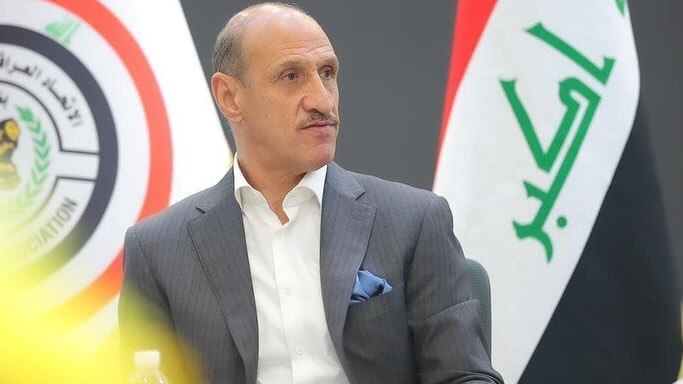
The failure is not only due to the limitations of the players or the coach's errors, but to a much more discreet institutional mechanism; we will explain what really happened.
Officially, Graham Arnold had the full trust of the Federation and was solely responsible for his squad lists, starting lineups, and tactical choices; in reality, President Adnan Dirjal gradually reduced his room for maneuver by maintaining around him balances that had become impossible to break, certain key players too costly to dismiss, players supported by internal networks, a generational renewal constantly delayed, and young players called for in public debate but never truly established.
The question would therefore no longer be simply why Arnold persists with certain players whose international level is contested, but to determine if he still truly has the power to dismiss them, because a coach can be responsible for his visible decisions while operating within a system that silently limits the decisions he is allowed to make.
The perfect trap: letting the coach bear the responsibility for choices that are no longer entirely his own
It was enough to let Arnold appear as the sole decision-maker while gradually reducing his scope of choice, to preserve certain statuses in the locker room, to delay the arrival of young players, to keep profiles despite repeated errors, and to let the coach compensate with permanent adjustments, positional changes, and improvised solutions.
In this interpretation, the communication difficulties within a linguistically fragmented group took on an even more disturbing dimension: Arnold was no longer just building the best possible team, he was trying to make a squad function together whose composition and balance he did not fully control, even organizing certain partnerships according to spoken languages and multiplying adaptations to maintain minimal coherence.
The trap was then almost perfect: seemingly free enough to be held responsible, but not free enough in reality to genuinely rebuild, while every individual error, every bad result, and every contested choice progressively reinforced the public idea that the problem bore a single name, that of the coach.
Failure as a tool for regaining control
After fulfilling his mission by bringing the national team back to the world stage, Arnold became too visible, too popular, and too autonomous, to the point of embodying the project more than the Federation itself.
For a president anxious to regain control of the narrative, the locker room, and the sporting future, a direct confrontation would have been risky, because directly dismissing the man associated with the World Cup return could have provoked a public backlash.
The most effective strategy was therefore not to artificially provoke a defeat, but to allow the conditions for success to deteriorate: maintaining players whose level is questionable, preserving certain internal balances, slowing down renewal, letting Arnold absorb the contradictions of the group, and then waiting for the results to progressively transform the qualification hero into the face of failure.
From then on, the final question was no longer only whether some players had been overestimated, nor why Arnold continued to trust them, but whether this trust was still entirely his own: Did Graham Arnold fail by his own choices, or did the Federation president methodically build an environment around him in which failure became, in the long run, the only possible outcome to regain control?


Leave a comment
This site is protected by hCaptcha and the hCaptcha Privacy Policy and Terms of Service apply.